
Blog / Exam Prep / CPA Study Planner: Your Week-by-Week Prep Schedule
Exam Prep
CPA Study Planner: Your Week-by-Week Prep Schedule
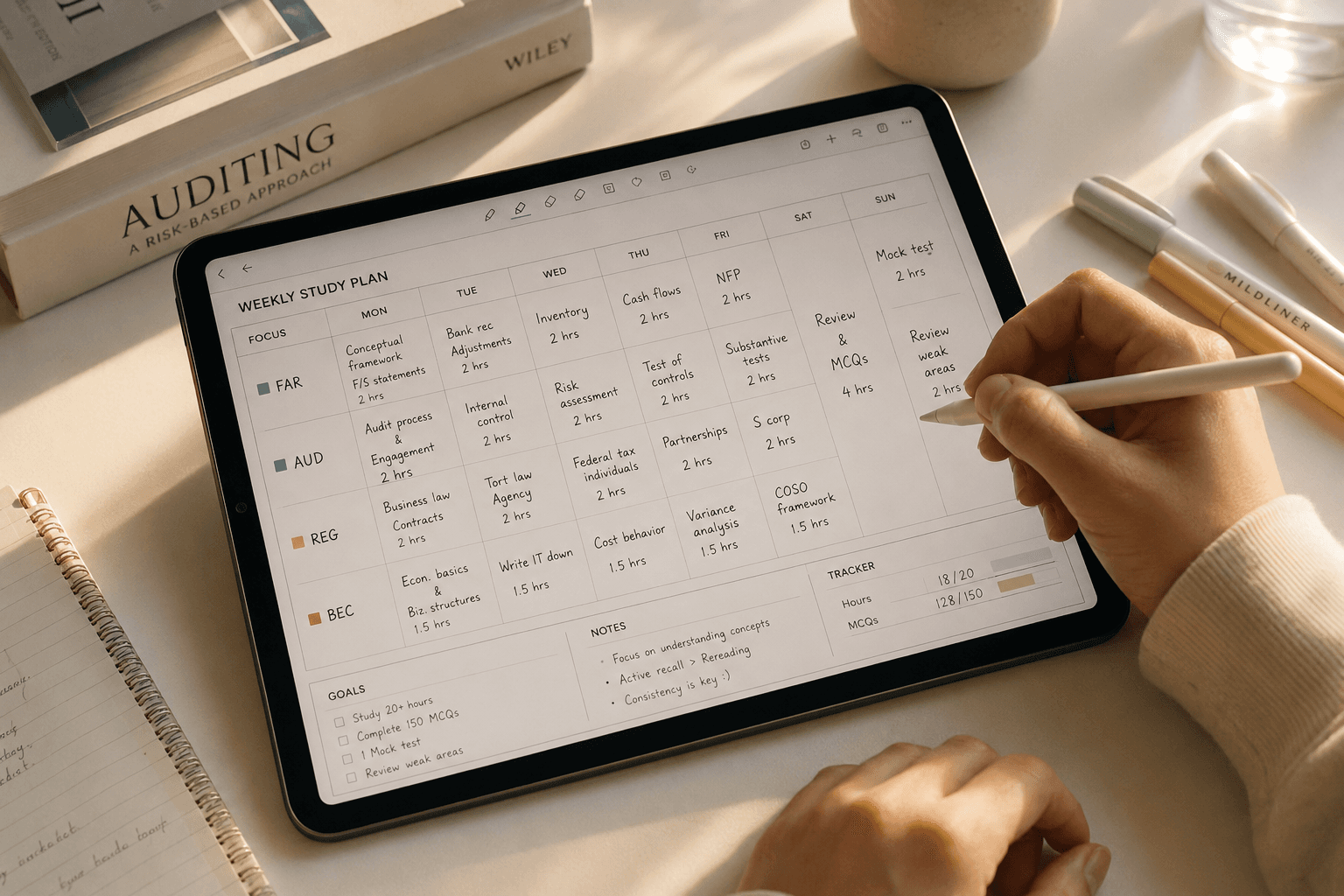
Most people who sit for the CPA exam spend somewhere between 300 and 400 hours studying. That number sounds massive when you first hear it, and honestly, it is. But the difference between candidates who pass and candidates who keep rescheduling usually comes down to one thing: they had a plan, and the plan had structure.
Not a vague "I'll study three hours tonight" kind of plan. An actual week-by-week schedule that accounts for all four sections, builds in review time, and doesn't pretend you have zero other obligations.
That's what this guide is. A realistic CPA study planner you can follow whether you're working full time at a firm, finishing up your master's, or somewhere in between.
The Four Sections and How Long Each One Takes
Before you map out a schedule, you need to know what you're scheduling. The CPA exam has four sections, and they're not created equal in terms of study time:
FAR (Financial Accounting and Reporting) is the largest section by a wide margin. Most candidates spend 120 to 150 hours here. It covers government accounting, nonprofit accounting, consolidations, leases, revenue recognition, and essentially everything from your intermediate accounting courses compressed into one test. If you're going to start anywhere, most people start here because it has the highest fail rate and you want it behind you while your momentum is fresh.
AUD (Auditing and Attestation) runs about 80 to 100 hours for most people. The material isn't as dense as FAR, but the questions are tricky. You'll spend a lot of time on audit reports, internal controls, and professional responsibilities. If you've worked in audit, some of this will feel familiar. If you haven't, give yourself the full 100 hours.
REG (Regulation) covers federal taxation and business law. Budget 80 to 100 hours. The tax portion is heavy, and the rules change frequently enough that you want relatively current study materials. Business law (contracts, agency, debtor-creditor) is less intuitive but also less voluminous.
BEC (Business Environment and Concepts) is generally considered the shortest section to prepare for, at around 60 to 80 hours. It covers economics, IT, corporate governance, cost accounting, and financial management. The material is broad but not as deep as the other sections.
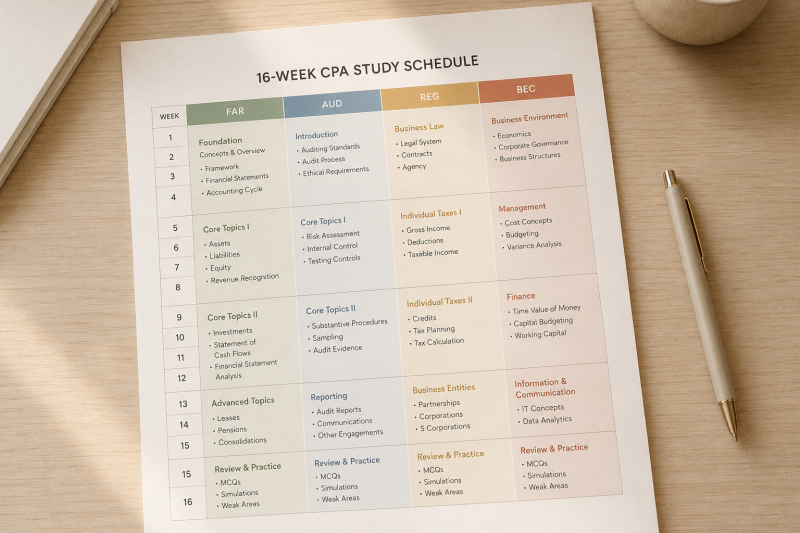
A Realistic 16-Week CPA Study Planner
Here's a week-by-week schedule that assumes you're studying 20 to 25 hours per week. That's roughly 3 to 4 hours on weekdays and 4 to 5 hours on each weekend day. If you're studying full time without a job, you can compress this into 10 to 12 weeks by increasing your daily hours.
Weeks 1 through 5: FAR
This is your longest and hardest stretch. Break FAR into topic blocks rather than trying to cover it linearly:
Week 1 covers the conceptual framework, financial statements, and cash flow statements. These are the foundations everything else builds on, so don't rush through them even if they feel basic.
Week 2 tackles inventory, fixed assets, intangibles, and leases. The new lease standard (ASC 842) shows up frequently, so spend extra time here if the rules feel unfamiliar.
Week 3 is bonds, equity, revenue recognition, and stock compensation. Revenue recognition under ASC 606 is a favorite of the exam writers. Work through as many practice problems as you can find.
Week 4 covers government and nonprofit accounting, consolidations, and foreign currency transactions. Government accounting tends to trip people up because it uses a completely different framework than commercial accounting. Don't skim it.
Week 5 is a pure review week for FAR. Take at least two full-length practice exams. Identify your weakest areas and drill those topics specifically. Don't spend review time on topics you already know well.
Weeks 6 through 8: AUD
Week 6 covers the audit process, planning, risk assessment, and internal controls. Focus on understanding the flow of an audit from engagement acceptance through reporting.
Week 7 tackles audit evidence, sampling, and specific audit areas (revenue, inventory, receivables). Practice the task-based simulations here since AUD simulations tend to be document-heavy.
Week 8 is audit reports, reviews, compilations, attestation engagements, and ethics. Spend the last two days on a full-length AUD practice exam and targeted review.
Weeks 9 through 11: REG
Week 9 covers individual taxation: filing status, gross income, adjustments, deductions, credits, and AMT. Individual tax is the single largest topic in REG. Know the rules cold.
Week 10 is entity taxation (C corps, S corps, partnerships, trusts, estates) and property transactions (basis, gains, losses, like-kind exchanges). Entity tax can feel overwhelming because each entity type has its own rules, but the exam tends to focus on the same core concepts repeatedly.
Week 11 covers business law and professional ethics, plus a full REG review with a practice exam. Business law is a smaller portion of the exam, but the questions are straightforward if you've reviewed the material, so don't skip it entirely.
Weeks 12 through 14: BEC
Week 12 covers economics, corporate governance, and IT concepts. The IT portion includes data analytics, cybersecurity concepts, and system controls.
Week 13 is cost accounting, financial management, and ratio analysis. If you've taken a managerial accounting course, a lot of this will come back quickly.
Week 14 is BEC review and a full practice exam. BEC is the section where people most often feel "ready enough" and skimp on review. Don't. The pass rate is high, but the people passing are the ones who still put in the review hours.
Weeks 15 through 16: Final Review and Buffer
Week 15 is your final review across all four sections. This is not the time to learn new material. Focus on your weak spots from practice exams, re-drill the areas where you consistently miss questions, and get comfortable with the exam software interface if you haven't already.
Week 16 is your buffer week. If you stayed on track, use it for light review and rest. If you fell behind earlier (which happens to almost everyone), this is your catch-up window. Having this built in from the start means falling behind in week 3 doesn't derail your entire timeline.
Study Session Structure That Actually Works
A lot of CPA candidates sit down for a three-hour study block and spend the first 20 minutes deciding what to study. Then they passively read a textbook chapter, highlight some things, and call it done. That's not studying. That's sitting near a textbook.
Here's a better structure for each daily session:
Start with 10 minutes of review from yesterday's material. Don't re-read your notes. Try to recall the key concepts from memory, then check yourself. This spaced recall is what actually builds long-term retention.
Spend the next 60 to 90 minutes on new material. Watch the lecture or read the chapter actively, pausing to work through examples as you go. Don't just watch. Pause, attempt the example yourself, then check the solution.
Finish with 30 to 45 minutes of practice multiple choice questions on the topic you just covered. Aim for 20 to 30 MCQs per session. Review every wrong answer thoroughly. The explanations for wrong answers teach you more than the ones you got right.
Common Mistakes to Avoid
Studying all four sections simultaneously instead of one at a time. The 18-month testing window is generous. Use it sequentially.
Spending too long on one section. If you've been on FAR for 8 weeks and still don't feel ready, you're probably over-studying it. Take the practice exam, see where you actually stand, and move forward.
Neglecting practice exams. Reading and watching lectures feels productive, but the exam tests application, not recognition. You need to practice under timed conditions with unfamiliar questions.
Ignoring the simulations. About 50% of your exam score comes from task-based simulations, not multiple choice. Practice these specifically, especially document review simulations.
How a Digital Study Planner Helps
A physical planner works fine for some people, but a digital planner on your iPad or tablet has a few specific advantages for CPA prep.
You can duplicate weekly spread pages for each study week without rewriting your layout every time. You can hyperlink between your weekly schedule and your section-specific notes so jumping between FAR review and your AUD timeline is one tap instead of flipping through pages. And you can carry it everywhere, which matters when you're squeezing in study sessions during lunch breaks or between client meetings.
Our Smart Class Planner was built for exactly this kind of structured, multi-week academic prep. It has 52 weekly spreads with built-in habit tracking, a semester overview you can repurpose as a section-by-section CPA timeline, and tappable navigation so you're never scrolling through hundreds of pages to find this week's schedule.
It works with GoodNotes, Notability, Xodo, and any PDF annotation app, so it fits whatever device and app you're already using.
Frequently Asked Questions
How many hours a week should I study for the CPA exam?
Most successful candidates study 20 to 25 hours per week over 12 to 16 weeks. If you can study full time, 30 to 40 hours per week lets you finish in 8 to 10 weeks, but the intensity is harder to sustain.
What order should I take the CPA exam sections?
The most common and generally recommended order is FAR first (hardest and most voluminous), then AUD, REG, and BEC last. But if you have strong tax experience, starting with REG can build early confidence. There's no single right order.
Can I study for the CPA while working full time?
Yes, and most candidates do. The 16-week schedule in this guide is specifically designed for people working full-time jobs. The key is consistency over intensity. Three hours every weeknight beats ten hours on Saturday alone.
How do I know when I'm ready to sit for a section?
When you're consistently scoring 70% or above on full-length practice exams under timed conditions, you're in the range. Waiting until you feel "completely ready" often means you never sit. A 75 is passing.
Is it worth using a study planner for CPA prep?
If you're self-studying or supplementing a review course, a structured planner keeps your 300+ hours on track across months of preparation. Without one, it's very easy to lose momentum after the first few weeks and start drifting on your schedule.